
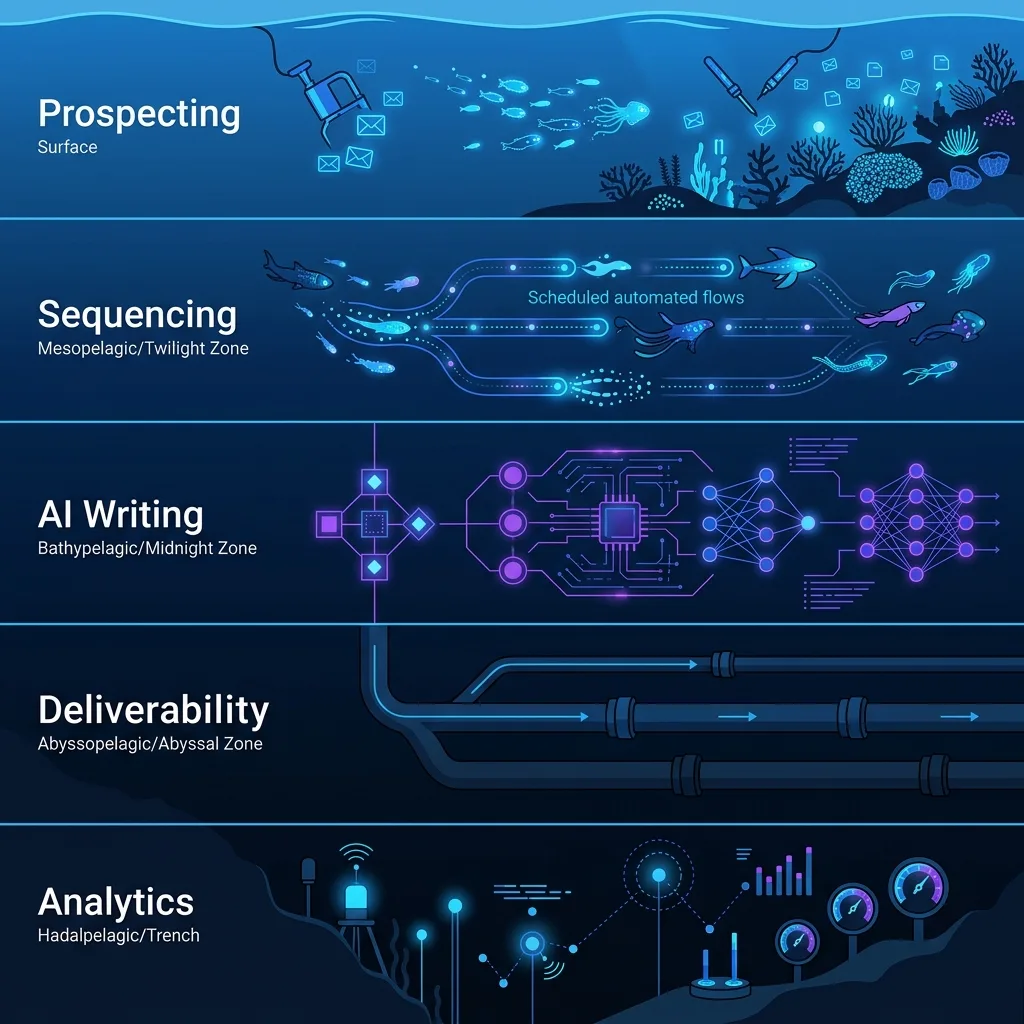
Key Takeaways
- →A predictable pipeline requires a system, not a person - people have bad weeks
- →The 4 variables that control outbound pipeline: list quality, messaging, timing, volume
- →Most teams fix messaging when list quality is the actual bottleneck
- →AI-run outbound compounds over time. Human-run outbound plateaus.
An outbound sales pipeline should be a predictable machine: qualified contacts go in, meetings come out, and the ratio between those two numbers compounds over time as you learn what messaging works.
In practice, most B2B companies experience something different - a leaky, inconsistent system that produces intermittent results and requires constant manual effort to keep moving.
The most common reason is sequence: teams build outbound in the wrong order. They write copy before they have a sharp ICP. They buy a contact list before their sending infrastructure is ready.
They launch sequences before their domains are warmed. Each misordering compounds into the next, and the whole system underperforms from day one.
This playbook covers the correct build order - six steps, each one dependent on the previous - with specific benchmarks at every stage.
The client numbers come from Deep-Y's own campaigns, including the Figureit engagement, where 900 targeted agencies produced 158 replies, 64 demos and 8 recurring paying clients.
What Is Outbound Sales?
Outbound sales means contacting potential buyers by cold email, phone or LinkedIn before they express interest, to move them into your pipeline.
Outbound differs from inbound in one fundamental way: you choose the prospect, not the other way around. That changes everything about how the system needs to be built.
When a prospect contacts you, your job is qualification.
When you contact a prospect, your job is relevance - proving, in the first 30 words, that you have a specific reason to be in their inbox right now.
Done correctly, outbound is the fastest way to build pipeline for a product with a specific, well-defined buyer.
Done incorrectly, it damages your domain reputation, alienates potential customers, and produces a pipeline full of unqualified meetings that burn sales team time.
The 4 Stages of a B2B Outbound Pipeline (and What Good Looks Like)
Before you build anything, map the four stages your pipeline will run through. Each stage has a conversion rate benchmark.
If you're below the benchmark, you have a specific problem at that stage - not a general outbound problem.
These targets are achievable with a properly built system. In the Figureit campaign, about 17.6% of targeted agencies replied and about 40% of those replies booked a demo.
The 6-Step Outbound Pipeline Build
Define Your ICP - 3 Criteria That Matter, 2 That Don't
Most ICP exercises produce a profile that's too broad to be useful. "B2B SaaS companies, 50-500 employees, Series A or later" describes 40,000 companies.
You can't write a relevant email to 40,000 companies - you can only write a generic one.
The 3 criteria that predict a closed deal:
(1) company revenue, not headcount, because revenue sets budget and deal size; (2) the buying trigger that makes them need you now; (3) the decision-maker title that controls the budget.
The 2 criteria that don't predict closed deals: industry vertical (unless your product is industry-specific) and tech stack (tells you what they use, not what problem they're trying to solve).
Example persona from the Figureit campaign: marketing agencies in Israel with small teams (up to about 25 employees) whose business is PPC-led.
Each agency's website was scraped and classified to confirm which PPC channels it runs (Google, Facebook, Taboola), so every sequence could speak to that exact channel mix.
Build Your List - Data Sources and Volumes
Apollo for volume prospecting: filter by title, headcount, location and funding, and export 2,000-3,000 contacts per ICP segment.
Clay for enrichment: layer job postings, funding and hiring signals on the Apollo base. Sales Navigator for high-value segments that need verified titles.
The rule on list size: start with 2,000-3,000 contacts per segment, not 20,000.
A smaller, well-enriched list outperforms a large, raw list on every metric that matters - open rate, reply rate, and meeting quality.
Before a contact enters the outreach queue, it needs at least 2 real-time signals matching the buying trigger.
The right title at the right company size is not a qualified lead. The right title at a company that just posted 12 sales roles in a new market is.
Set Up Your Sending Infrastructure - Domains, Warmup, Limits
Infrastructure is where most DIY outbound programs fail.
Teams skip this step, send cold email from their primary domain at high volume, destroy their deliverability, and blame the copy when replies never come.
Register sending domains on a separate root from your brand (the brand sends from deep-y.com; outbound from deepy-team.com). Configure SPF, DKIM and DMARC before any send.
Warm each domain for 3-4 weeks with Mailreach, Warmy or Instantly, starting at 5-10 emails a day.
After warmup, cap sends at 40 cold emails per domain per day.
For a 400-contact/week program, you need 10 sending domains rotating.
This sounds like overhead - it's actually cheap insurance.
A single deliverability incident can take 4-6 weeks to recover from.
Write Your Sequence - First Touch + 3 Follow-Ups
A 4-touch sequence covers the majority of your pipeline opportunity.
Day 1 - first touch: open with the specific signal that put this contact in your queue ("Saw you're expanding into Phoenix - congrats on the growth").
One sentence on what you do, one sentence on a relevant proof point, one low-friction ask (a 20-minute call, not a demo). Under 120 words total.
Day 4 - first follow-up: add one proof point specific to their segment (a client result from a company similar to theirs). Re-ask with slightly different framing. Under 80 words.
Day 9 - second follow-up: different angle - address the most common objection your ICP has without them asking. Under 60 words.
Day 14 - close-out: "Closing this thread - if the timing ever shifts, we'd be glad to connect." No guilt, no pressure. Under 30 words.
Cadence matters as much as content. Space touches 4-7 business days apart and send Tuesday to Thursday, early in the recipient's morning.
Qualify and Book Meetings - Scoring, Criteria, First Call
Not every reply is a lead. Score reply intent before booking a meeting. Positive replies ("yes, interested" / "can we find time?" / "send me more info") get an immediate calendar link.
Ambiguous replies ("maybe later" / "tell me more") get one clarifying question before the calendar link. Negative replies get a graceful exit and a note to re-contact in 90 days.
On the first call, confirm 3 things before talking about your service: (1) budget authority - are they the decision-maker, or do they influence it?
(2) active timeline - are they solving this problem in the next 60 days or exploring for next quarter?
(3) the specific problem - what exactly is not working right now, and what have they already tried?
Contacts who score positively on all 3 become active opportunities.
In the Figureit campaign, 64 of 158 replies (about 40%) booked a demo, because the replies came from agencies that had the problem.
Measure and Optimize - 5 Metrics That Matter, 3 That Don't
Track 5 metrics weekly: open rate (target 70%+; below 50%, fix deliverability first), reply rate (target 5-8%) and positive reply rate (target 2-3%).
Also meeting booked rate (target 1.5-2% of contacts) and pipeline value per contact, your most important number.
Stop tracking these 3: total emails sent, LinkedIn connection count and bounce rate below 3%. Chasing volume over quality is what kills most outbound programs after month two.
Fix the weakest stage first. At a 40% open rate and 6% reply rate, fix deliverability before touching copy.
At an 85% open rate and 1% reply rate, the emails land but the offer or targeting is wrong.
Infrastructure is where most teams stall out.
Domain setup, warmup and deliverability take 6-8 weeks to get right from scratch. We build and operate the full stack for B2B teams.
The AI Shortcut: From 6 Months to 30 Days
AI shortcut: how the 6-month manual pipeline build compresses to 30 days with automation.
A manually built outbound pipeline takes 4-6 months to produce consistent results for a team starting from scratch.
Each stage adds time: deliverability mistakes cost weeks, a poor ICP means rebuilding the list, and sequence optimization needs 3-4 weeks of data.
An AI lead generation system collapses this timeline to 30 days because it eliminates the learning curve at each stage.
AI tools run signal monitoring at scale - Clay processes company records against real-time data sources, something a manual researcher can do for maybe 200 accounts per week.
AI SDR systems personalize and send sequences without SDR headcount, and they do it at 400 contacts per week without deliverability variance from human error.
The compressing effect is real. An AI-assisted build reaches in weeks what a manual build takes months to reach, and then keeps compounding from that baseline.
Real Case: Figureit, 900 Agencies to 8 Paying Clients
Figureit is a GTM-stage analytics startup: a platform that connects data sources into live dashboards. It needed its first repeatable way to reach the buyers most likely to use it.
The build used exactly this sequence. The ICP was PPC-led marketing agencies in Israel with small teams (up to about 25 employees).
Deep-Y built a list of 900 of them, scraped each agency's website and used AI classification to confirm it is PPC-led and which channels it runs (Google, Facebook, Taboola).
The cold email sequences, run in Smartlead, were segmented by each agency's PPC channel mix, so every message spoke to the channels that agency actually manages.
About 40% of replies booked a demo, and 8 of 64 demos became paying clients.
The full story is in the Figureit case study.
What to Outsource vs. Build In-House
The decision framework is simple. Build in-house anything that needs internal product knowledge.
Outsource the technical system problems where specialists have built up compounding experience.
| Component | In-House or Outsource? | Why |
|---|---|---|
| ICP definition | Build In-House | Requires deep product knowledge and understanding of why customers actually buy. An agency can facilitate but not own this. |
| Offer framing and positioning | Build In-House | Your offer differentiation is an internal strategic decision. |
| Qualification criteria and first-call script | Build In-House | Only your sales team knows what signals predict a closed deal. Define these internally before any outreach system is built. |
| Infrastructure setup and deliverability management | Outsource | Domain reputation, warmup, and deliverability monitoring are technical systems where specialists have compounding experience. |
| List building and signal enrichment | Outsource | AI-assisted list building at scale (Clay, Apollo, custom signal stacks) has a steep learning curve and requires ongoing tool maintenance. The ROI on outsourcing is clear in speed and list quality. |
| Sequence writing and A/B testing | Outsource | B2B cold email copywriting is a specialized skill. |
| Ongoing optimization and reporting | Outsource | Weekly tuning means watching 5+ metrics across infrastructure, list quality and sequences at once: a full-time job, not a side task. |
The practical implication: most growth-stage B2B companies should own ICP, offer, and qualification logic, and outsource the system build and operation.
This keeps your team focused on what only you can do while avoiding the 6-month learning curve on technical infrastructure.
The Fastest Path from Zero to Pipeline
Building an outbound pipeline from scratch is a 6-step systems problem, not a creative one.
The teams that produce results fastest are the ones who respect the sequence: ICP before list, list before infrastructure, infrastructure before sequences, sequences before optimization.
Skipping steps doesn't save time - it creates rework that costs more time than the step would have.
With AI automation, the timeline compresses from 6 months to 30 days. For Figureit, the same build order turned a list of 900 agencies into 8 recurring paying clients.
Building outbound from zero, or fixing a program that isn't working? Start with a 30-minute call.
We map the ICP, find the 2-3 strongest buying triggers in your market and give you a realistic build timeline.
Frequently Asked Questions
How long does it take to build an outbound sales pipeline from scratch?
What is a realistic open rate for cold email outreach?
What metrics actually matter for an outbound pipeline?
What should I outsource versus build in-house for outbound?
Build your outbound pipeline in 30 days.
On the call, we map your ICP, identify your highest-signal buying triggers, and show you what a pipeline system looks like for your market.