
Key Takeaways
- → Follow-up emails often out-reply the first send; email 4 frequently beats email 1.
- → Most reps stop after one touch, which leaves most replies uncaptured.
- → The breakup email (touch 5, Day 21) consistently achieves the highest reply rate by triggering loss aversion.
- → 5 touches over 21 days is the optimal ceiling - beyond that you're burning list with minimal marginal return.
Here's the number most SDRs ignore: follow-up emails get more replies than the initial send.
In our experience, email 4 - the direct "is this a no?" message - often outperforms email 1 on reply rate.
Yet most reps give up after one touch. Or they send a follow-up that says "just checking in" - which is the outreach equivalent of showing up to a first date and saying "so… are you interested?"
The failure mode isn't lack of follow-up. It's lazy follow-up. The same non-value, the same framing, repeated until the prospect either ignores you long enough or asks to be removed.
The Psychology of Follow-Up: Why They Don't Reply to Email 1
Before you build the sequence, you need to understand what's actually happening in the inbox. Most non-replies are not rejections. They're interruptions.
This is the majority of your list. Not interested and not ready are two completely different states.
Your sequence should catch the "not ready yet" group and make it easy for the "not interested" group to say so, so you stop messaging them.
What changes their mind between touch 1 and touch 4? Usually one of three things:
- Timing shifts. Q3 planning starts, a competitor poaches a rep, a board meeting creates urgency. Be in their inbox when that window opens.
- New information. Each follow-up adds something new: a result, a case study, a different angle. More data gives them a reason to revisit.
- Social proof. A recognizable company that solved the same problem with you is among the strongest things a follow-up can carry. It is evidence, not a claim.
The breakup email (touch 5) adds a fourth reason: loss aversion. When something is being taken away, people check whether they wanted it.
That is why the last email often gets the most replies.
One caveat: none of this works if the emails never reach the inbox.
If your open rates are low, the problem is usually the deliverability layer, not the sequence.
The 5-Touch Cold Email Follow Up Sequence Framework
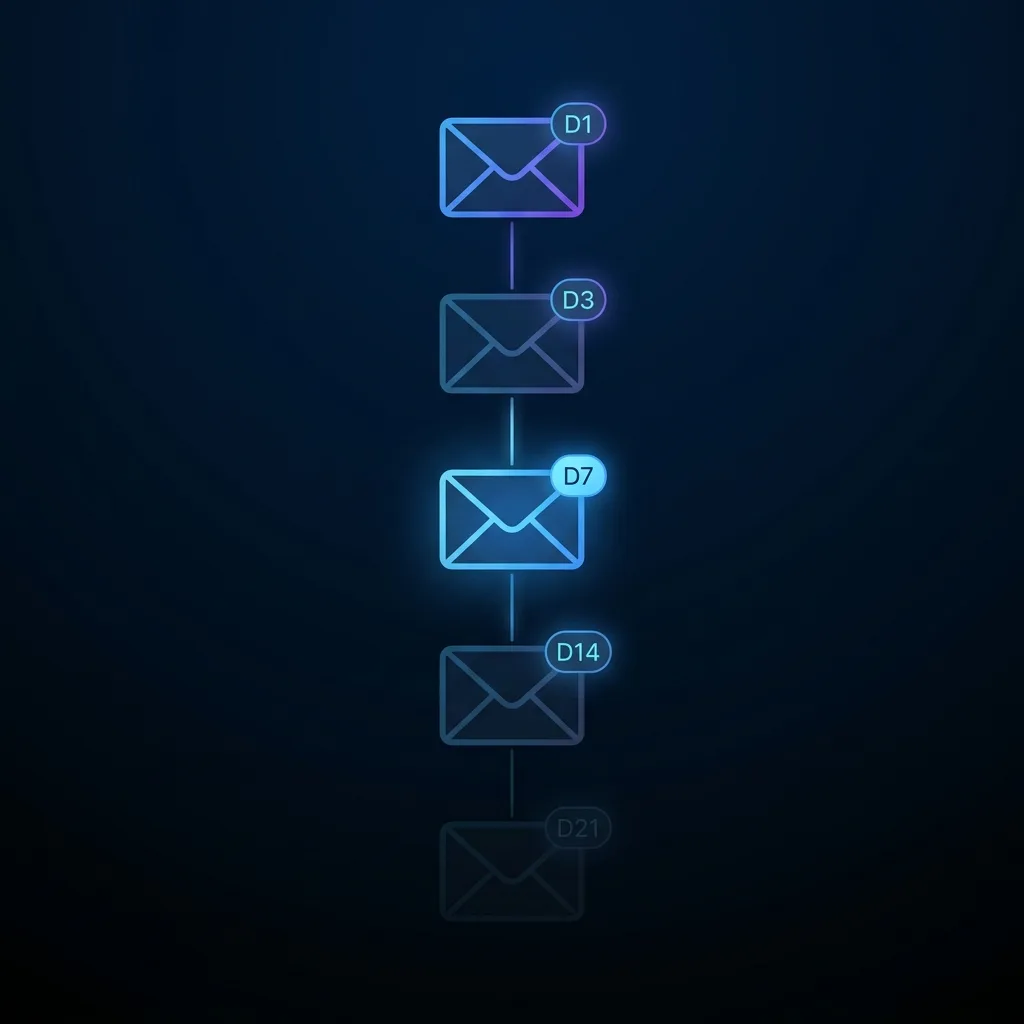
The 5-touch sequence: timing intervals, message roles, and the pivot logic between each touch.
Five touches. Minimum 3 days between each. Maximum 21 days total.
Every email earns its place by adding something the last one didn't. Here's the structure:
| Touch | Day | Job | Core mechanic |
|---|---|---|---|
| Email 1 | Day 1 | Cold pitch | Value-first, one specific claim, low-friction ask |
| Email 2 | Day 3 | New angle | Different framing or new piece of information |
| Email 3 | Day 7 | Social proof bump | Specific case study result relevant to their role |
| Email 4 | Day 14 | Direct ask | "Is this a no?" - removes pressure, invites a binary answer |
| Email 5 | Day 21 | Breakup | Explicitly close the loop - triggers loss aversion, highest reply rate |
Each email replies in the same thread, so context builds and the prospect can scroll up.
They don't have to remember who you are or re-read your pitch.
Templates for Each Touch
The following templates are B2B-relevant and battle-tested across our client campaigns. Adapt the specifics to your ICP - the structure is what matters. Keep bodies under 80 words.
One idea per email. Never use "just checking in."
Email 1: Value-First Cold Pitch (Day 1)
One specific result. Low-friction ask (20 minutes, not "a demo").
Email 2: New Angle / New Information (Day 3)
The opener turns "our pitch didn't land" into a diagnosis. Naming specific failure points (domains, warm-up, DMARC) makes the claim checkable for skeptical buyers.
Email 3: Social Proof Bump (Day 7)
Numbers make this real. You're not saying "we get great results" - you're saying specifically what happened for a named company.
Email 4: Direct Ask - "Is This a No?" (Day 14)
Email 4 is the highest-converting touch in most sequences. It removes pressure by explicitly naming the option to say no.
Email 5: Breakup Email (Day 21)
Breakup emails often get the most replies in a follow-up sequence, even from people who never opened earlier touches. Promising to stop removes friction.
What Our Sequences Look Like in Practice
The Architrainer campaign shows the follow-up layer at work. Architrainer sells BIM and systems-coordination services into the Israeli architecture market: small, technical and slow to adopt.
We defined the ICP and project size, then ran multi-step sequences with a follow-up plan shared with Architrainer's team, including in-person follow-up.
The result: an 81% open rate across 124 sequences, 19 opportunities, and 8 deals closed or in process.
The structure mattered more than the copy: the right list, and follow-ups that kept adding a reason to reply.
The principles behind sequences that hit numbers like that:
Every email should be reducible to one sentence. If you need two sentences to explain what the email is about, cut one of them.
Each email should contain something the previous one didn't. A new angle, a new result, a new offer, a new framing of the problem.
We cap email bodies at 80 words. Not 100, not "around 80." Eighty.
A perfect sequence still fails if sending infrastructure is wrong. Domain age, warm-up volume, SPF/DKIM/DMARC alignment and reply-to setup decide whether it reaches the inbox.
The Timing and Volume Rules
These are the hard rules we run every sequence by. They're not suggestions - they're the difference between a sequence that books meetings and one that burns your domain reputation.
| Rule | Detail |
|---|---|
| Best send days | Tuesday to Thursday. Monday is buried by weekend backlog; Friday sends get opened too late. |
| Best send time | 9-11am in the prospect's timezone, not yours. Use a tool that schedules by timezone. |
| Minimum gap between touches | 3 days. Shorter feels robotic, and 3 days leaves time for delayed opens and auto-pause on reply. |
| Maximum sequence length | 5 touches over 21 days. After that, returns fall and flag risk rises; no reply after 5 emails is a no. |
| Auto-pause on open or click | Pause the sequence when someone opens several times without replying, and have an AE or founder reach out by hand. |
| Daily send volume per inbox | Max 30-40 emails per inbox per day. For volume, rotate across multiple warmed domains. |
Five touches. Three is the floor; more than five burns the list.
Automating the Sequence
The manual version - scheduling 5 emails per prospect, tracking touches, pausing on replies, rotating inboxes - is a full-time job.
It breaks past about 50 active prospects.
The right answer is a dedicated cold email sequencing platform. The tools we typically configure for clients:
These tools handle sending infrastructure, inbox rotation, timezone scheduling, reply detection and pausing.
Their analytics show which touch generates replies, and which to cut or rewrite.
The harder problem is configuration, not the tool: deliverability, sequence logic, ICP targeting, copy, and ongoing A/B tests.
Most DIY outreach fails at that operational layer.
Want to run it yourself? The templates above are a working start.
Want it built and operated, with infrastructure and ongoing iteration included? That is what Deep-Y does.
Want this built and running for your pipeline?
We design, build and run cold email outreach systems, including the sequences, infrastructure and deliverability setup in this article.