
Key Takeaways
- → A 5-layer AI sales stack requires every layer functioning together - a broken deliverability layer makes even perfect prospecting worthless.
- → Running a complete DIY stack costs $682/month minimum in tooling, plus 10-14 hours/week to operate correctly.
- → Apollo provides database volume; Clay waterfalls 50+ enrichment sources to validate and signal-enrich each contact.
- → Smartlead plus disciplined deliverability infrastructure is what we run for clients - Figureit's campaign produced 158 replies and 64 demos from 900 targeted agencies.
Each tool solves one problem in a five-layer system, with its own learning curve, failure modes and bill.
That's why most B2B teams evaluate six tools, buy three, use two, and see no change in pipeline.
What this article is not: a sponsored comparison or an affiliate roundup. We have paid for and run every tool here at production scale.
The prices are real, and the limitations are ones we hit ourselves.
The 5 Layers of a B2B Outreach Stack
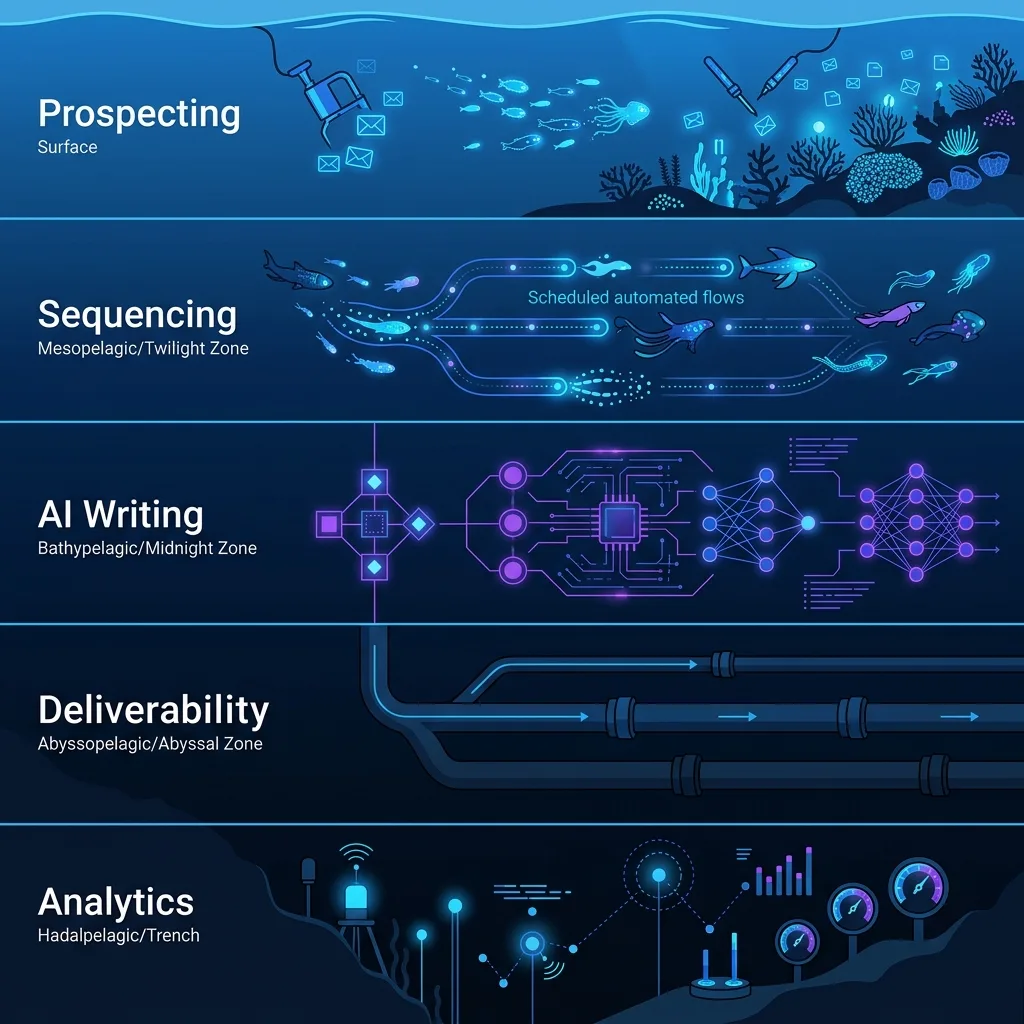
Before evaluating any single AI sales tool, you need a mental model for where it fits. There are five distinct functional layers in a working outbound system. Tools only make sense in context of the layer they serve.
A great prospecting tool paired with a broken deliverability layer is worthless - your perfectly-sourced list never lands in an inbox.
Finding the right companies and contacts. Who to target, what signals indicate buying intent, and whether the contact data is accurate enough to send to.
Generating or coaching copy that converts. Personalizing at scale so each message feels written for the individual - not for a list of 2,000.
Managing the timing, cadence, and multi-touch structure of your outreach. Automating follow-ups, A/B tests, and reply routing without manual intervention.
Getting emails to the inbox: domain reputation, warm-up, mailbox rotation, authentication and blacklist monitoring.
Understanding what's working at the campaign, sequence, and message level - and translating that data into decisions that improve the next cycle.
Most companies start at Layer 3 - they buy a sequencing tool and start sending. Then they hit deliverability issues and bolt on Layer 4. Then reply rates disappoint and they add a personalization tool for Layer 2.
Then they realize their data is stale and add a prospecting tool for Layer 1. They've built the stack backwards, and every layer was added reactively. We've seen this at almost every company that comes to us.
Start with the model, not the tool.
Prospecting & Data: Finding the Right Targets
Everything downstream depends on the data you start with. Bad data raises bounce rates, which hurts deliverability, which sinks open rates.
This layer deserves more investment than most teams give it.
Layer 01 - Prospecting ToolsEmail Sending & Sequencing: The Execution Engine
Most teams start with this layer, and it matters. But a sequencer is only as good as the deliverability underneath it.
The tools below assume mailbox rotation, warm-up and authentication are already in place.
If you haven't, even the best sequencer will land in spam.
Layer 03 - Sending & Sequencing ToolsAI Writing & Personalization: Making It Sound Human
This layer has gotten crowded fast. Three years ago it didn't exist as a category. Today there are 40+ tools claiming to write or optimize B2B cold email.
A well-prompted AI email can now match a strong human one, if you know what you're doing.
The tools below range from coaching you to write better to writing for you entirely.
Layer 02 - AI Writing ToolsDeliverability: The Layer That Kills Everything Else When It Fails
Deliverability separates professional outbound from amateur outbound. Most founders treat it as a setup task; it is an ongoing system.
The three tools below cover different parts of it. The full technical breakdown of a deliverability stack is here.
Layer 04 - Deliverability ToolsAnalytics: Build This Layer or Your Optimization Cycles Stay Blind
Native dashboards show output metrics: opens, replies, bounces. The decisions come from cohort data: which ICP segment books meetings, which sequence wins by deal size.
Build it in Notion or Sheets from weekly exports - about four hours to set up and thirty minutes a week to run.
The Real Cost of Managing This Stack Yourself
The math on a DIY AI sales tools stack is almost never run correctly before someone commits to it. Let's run it honestly.
That's the software floor, before Clay credit overages, Inframail, Lavender for team coaching, or a CRM integration layer.
At meaningful volume, tooling alone typically runs $800-$1,200 a month.
But the more expensive number is the operational cost. Running a 5-layer outbound stack correctly requires:
- 4 - 6 hours/week to build, review, and optimize sequences
- 2 - 3 hours/week for list building, enrichment, and data QA in Apollo + Clay
- 1 - 2 hours/week for deliverability monitoring (Postmaster Tools, blacklist checks, bounce rate review)
- 1 - 2 hours/week for analytics review and reporting interpretation
- Ad hoc hours for domain burns, list clean-up, and tool troubleshooting
The tools don't replace the work; they reorganize it. You still need a person running each layer, making judgment calls and catching failures.
We run this exact stack for you,
fully calibrated from day one.
Apollo, Clay, Smartlead, custom AI writing, deliverability infrastructure - wired together and operated by the team that built it.
Tool Stack vs. Done-For-You: The Decision Framework
There's a real case for running this stack yourself, and a real case for a system that is already wired.
The decision is about where you spend limited operational bandwidth.
The decision point isn't a capability question - it's an ROI question. At $10K+ ACV, one additional qualified meeting per month from a well-run DFY system more than pays for itself.
At $2K ACV with a team of two, you're probably better off learning the tools yourself and accepting some inefficiency in exchange for the operational knowledge you build.
What Deep-Y Actually Uses - And Why
We're not neutral observers here. We operate a full 5-layer outbound stack across multiple active B2B client accounts. Here's exactly what we run and why we made each call:
We've tested most major tools in every category. The stack above isn't the cheapest.
It's the one behind Architrainer's 81% open rate, Figureit's 158 replies from 900 targeted agencies, and 1 Solar Direct's 6.35% reply rate.
The tool choices matter less than the operational discipline applied to each layer.
That's the case for a done-for-you system. You can run Apollo and Smartlead yourself, but repeatable pipeline takes months of calibration we have already done.
The AI sales automation breakdown shows the full architecture and what it produced for Figureit.
Instead of managing 6 tools,
we run one integrated system for you.
Apollo, Clay, Smartlead, custom AI writing, deliverability engineering - all wired together, all operated by us, all running in your name. You get the pipeline. We handle the stack.