
Key Takeaways
- →Lumpy revenue is a pipeline consistency problem, not a cash flow problem.
- →The fix is building one system that runs continuously - not hiring more reps.
- →Figureit turned 900 targeted agencies into 42 pipeline opportunities and 8 recurring paying clients with cold email.
- →AI-run outbound compounds monthly. Referral-dependent revenue does not.
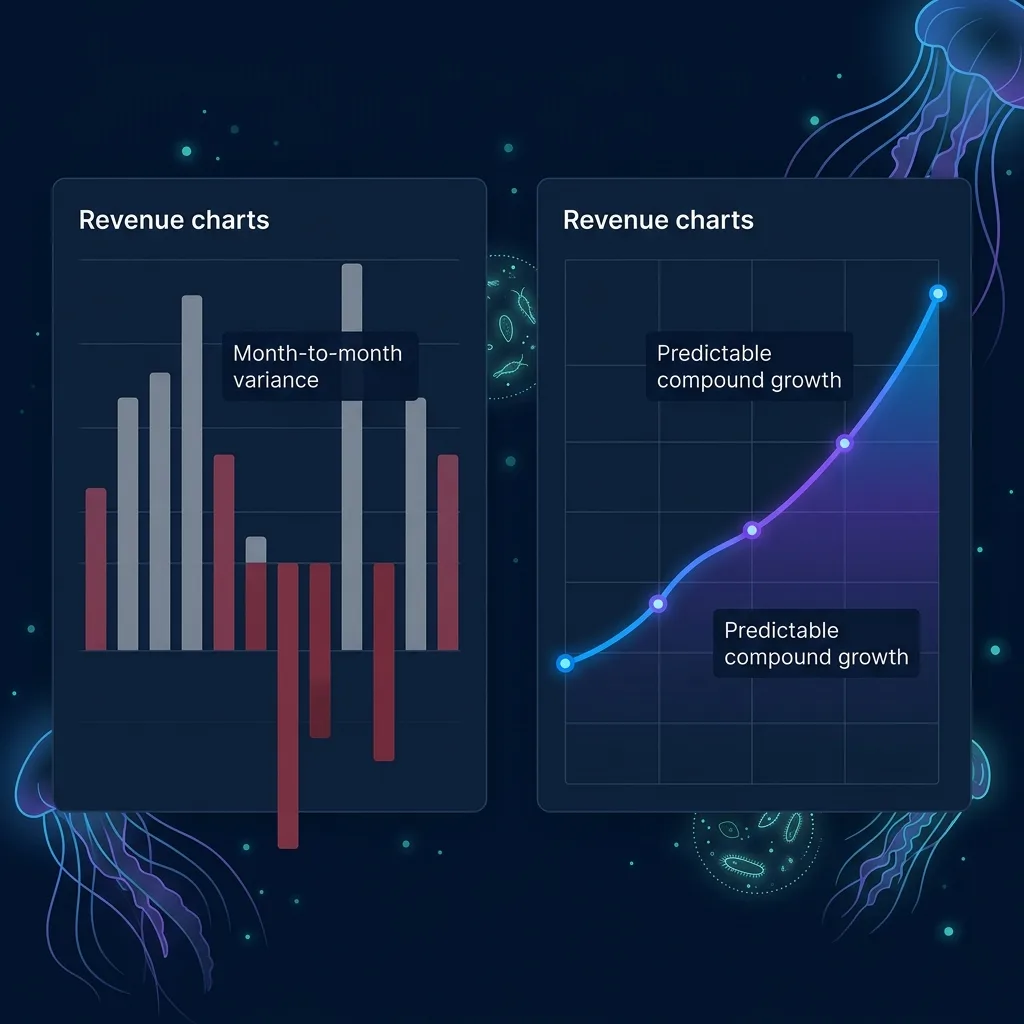
If your revenue is lumpy - great months followed by dry months, with no clear explanation for either - this article is for you.
You probably know the pattern. Q1 closes strong because of the pipeline you built in December. Q2 is empty because nobody was prospecting in Q1 while you were closing.
Board meetings get uncomfortable. The forecast is a guess dressed up as a number. Hiring decisions get delayed because you cannot commit to a revenue line you cannot predict.
This is not a cash flow problem. It is a pipeline consistency problem.
And lumpy revenue has one root cause: the pipeline that feeds your revenue is not a system - it is a series of one-off efforts, each disconnected from the last.
This article explains why revenue gets lumpy, what a real predictable pipeline system requires, and what the 90-day transformation looks like when you build it correctly.
Why Revenue Gets Lumpy: The 4 Root Causes
Lumpy revenue is almost never caused by a single failure. It is the accumulated result of 4 structural problems that most B2B companies have all at once.
Understanding which ones apply to you determines which parts of the 90-day system matter most.
- 1Founder-led sales hitting a ceiling
The founder is the best SDR in the company. When they are busy closing, nobody is prospecting.
- 2SDR churn breaks the engine every 18 months
Human SDRs are expensive, churn fast and take months to ramp.
- 3Single-channel dependency creates single-channel fragility
Over-reliance on one channel - inbound, referrals, one SDR's network, LinkedIn - means when that channel has a bad month, revenue craters. Referral networks are not reliable pipelines.
- 4The silent failure cascade
This is the one nobody talks about. Sending domains get blacklisted without anyone noticing.
What a Predictable Pipeline Actually Requires
Predictable pipeline is not more activity. More cold calls with the same broken list produces more noise, not more meetings.
What you actually need is a self-running system with 4 specific components working together. For companies that want this built end-to-end, see our done-for-you outreach service overview.
Signal-based targeting - finding the buyers, not the whole market
At any moment, only a small share of your ICP is in an active buying cycle; the rest will not convert however many touches you send.
Signal-based targeting finds those accounts by watching the events that show intent, such as a hiring surge, a funding round, a tech stack change or an expansion. Same copy, different targeting.
Technical infrastructure that runs 24/7
Verified lists, warmed domains, monitored deliverability: the unglamorous layer that decides whether your emails arrive. A fresh domain needs 4 weeks of warmup before real volume.
Verify your list before every campaign run, because people change roles all the time. Without this layer, nothing else works.
Multi-touch sequences that run without human intervention
An AI-powered outreach system combines email and LinkedIn in coordinated sequences that do not require a human to queue each message.
Email touch on day 1, LinkedIn connection on day 3, follow-up email on day 7, LinkedIn value message on day 12.
Each touch is personalized using live research on the prospect - company news, hiring patterns, recent trigger events.
The sequence runs for every qualified prospect without a human managing each step.
A measurement framework that tracks pipeline velocity, not vanity metrics
Open rates tell you if your emails are arriving. Reply rates tell you if your targeting is right. Meeting bookings tell you if your offer resonates.
Opportunities tell you if your qualification is working. Pipeline velocity - how fast deals move from first meeting to close - tells you if the system is producing revenue, not just activity.
Measuring opens and ignoring meetings is how companies stay blind to their actual pipeline problem.
The 90-Day Transformation: What Each Phase Builds
Most companies want results on day 30. The honest answer is: day 30 is when the foundation is done. Meetings start booking around day 45-49.
Consistent weekly flow arrives by day 75-90.
This timeline is not negotiable - it is determined by domain warmup physics and how long it takes for signal-targeted outreach to accumulate enough data to improve.
Here is what each 30-day block actually builds.
Foundation
ICP audit. Define the ICP by who actually closed.
Database scrub. Verify every contact before a single email sends.
Domain setup and warmup. 3-5 sending domains with SPF, DKIM and DMARC, warmed for 4 weeks.
Signal layer. 7-10 buying signals configured for the ICP.
Clean infrastructure. Warmed domains. Verified lists. Signal monitoring running.
Launch
First sequences go live. Precision at this volume keeps targeting focused.
LinkedIn coordination begins. Connection requests go to the same signal-qualified prospects receiving email.
First meetings typically book in weeks 5-7. Not day 31.
Qualified meetings booked. Pipeline starting to form. Optimization data accumulating.
Compound
Full volume launch. The optimization data determines which sequences get scaled and which get cut.
Referral triggers activate. Prospects who responded positively but did not convert immediately get warm intro sequences.
Reporting infrastructure goes live. Cost per meeting, cost per opportunity and pipeline velocity become visible.
Consistent weekly meeting flow. Pipeline no longer lumpy. Reporting in place.
We map the exact 90-day system for your ICP, deal size, and current outbound state. Free strategy call. No commitment until you see the full plan.
The Figureit Case Study: 900 Agencies to 8 Recurring Clients
Figureit is a GTM-stage analytics startup: a platform that connects data sources into live dashboards.
The goal was a repeatable way to reach the buyers who fit the product, instead of waiting for deals to show up.
The targeting layer started with a list of 900 marketing agencies in Israel with small teams of up to about 25 employees.
We scraped each agency's website and used AI classification to confirm it is PPC-led and which channels it runs - Google, Facebook, Taboola. That turned a broad category into a precise ICP.
The outreach layer ran cold email sequences in Smartlead, segmented by each agency's PPC channel mix.
Every segment got a message about the channels it actually runs, not a generic pitch.
The result: 158 replies (about 17.6% of targeted agencies) and 64 demos, 7.1% of the list and about 40% of everyone who replied.
Those demos produced 42 pipeline opportunities and 8 recurring paying clients. Recurring clients turn a one-off spike into predictable revenue.
What You Actually Need to Make This Work
This is not a system that works for every company at every stage. Honest prerequisites matter more than hype.
These are the 4 conditions that determine whether the 90-day framework produces results like the case above - or produces a well-built engine with no fuel.
- An ICP with real pain and budget. Deal size and urgency need to support the system.
- Someone who can run the sales calls. The system books meetings, but a skilled human still has to close them.
- 30-day patience for the foundation phase. The foundation keeps the launch phase out of the spam folder.
- Willingness to measure pipeline correctly. Meetings booked and opportunities opened are the metrics that matter.
The cold email infrastructure itself, including domain setup and deliverability monitoring, is covered in a separate walkthrough.
The point here is the 90-day arc and what each phase produces.
Frequently Asked Questions
What is predictable revenue in B2B?
How long does it take to fix lumpy revenue?
Do we need a large sales team for this to work?
What is the ROI timeline for fixing lumpy revenue with outbound?
Can this work for a niche B2B market?
If your revenue is lumpy, the fix is not working harder.
We audit your ICP, map the signal layer for your market, and deliver a 90-day pipeline roadmap. 30 minutes. No contracts until you see the full plan.