
← Deep-Y AI Sales Tools

Best AI Sales Tools for B2B Outreach in 2026
(Honest Comparison)

There are now 200+ tools claiming to fix your B2B pipeline. Most of them do one thing, require two others to work, and cost more than anyone admits in the pricing page. We use this stack daily across 8 live clients. Here's what each layer actually does - and where the stack breaks if you're running it alone.

MR
Maor Raichman
Founder, Deep-Y
April 12, 2026 11 min read

The AI sales tools market hit 200+ products in 2026, and the number keeps climbing. Most of them are real products with real users and real use cases. But buying any individual tool does not solve the actual problem - which is building a complete, working outbound pipeline and keeping it running at scale.

Each tool solves exactly one problem in a five-layer system, and every layer has its own learning curve, its own failure modes, and its own monthly bill. The marketing for each tool assumes the other four layers are already handled. They never are. That's why most B2B teams evaluate six tools, buy three, use two inconsistently, and see no change in pipeline output.

This article is our attempt to give you the honest map. We've tested most of the major tools across 8 live B2B client engagements spanning HVAC, SaaS, solar, data intelligence, and immigration services. We run this stack daily. What follows is a category-by-category breakdown of what actually works, what each tool costs, where each one falls short - and then a framework for deciding whether you should manage this yourself or hand it to a system that already has it wired up.

What this article is not: a sponsored comparison, an affiliate roundup, or a list of tools we've only demoed. Every tool in this article we have paid for and operated at production scale. The prices listed are real. The limitations listed are things we've run into ourselves.

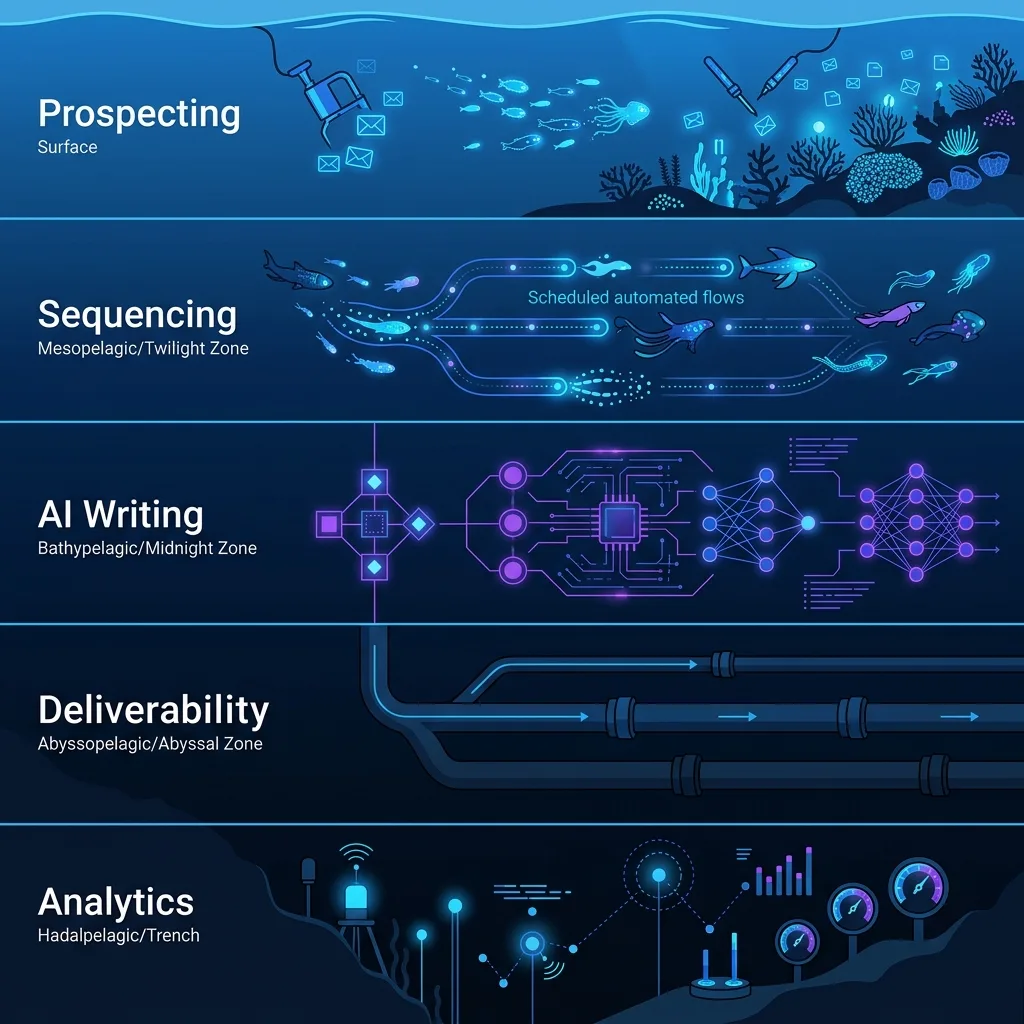
The 5 Layers of a B2B Outreach Stack

Before evaluating any single AI sales tool, you need a mental model for where it fits. There are five distinct functional layers in a working outbound system. Tools only make sense in context of the layer they serve. A great prospecting tool paired with a broken deliverability layer is worthless - your perfectly-sourced list never lands in an inbox.

01
Prospecting & Data

Finding the right companies and contacts. Who to target, what signals indicate buying intent, and whether the contact data is accurate enough to send to.

Apollo Clay Seamless.AI
02
AI Writing & Personalization

Generating or coaching copy that converts. Personalizing at scale so each message feels written for the individual - not for a list of 2,000.

Lavender Amplemarket ChatGPT
03
Sequencing & Sending

Managing the timing, cadence, and multi-touch structure of your outreach. Automating follow-ups, A/B tests, and reply routing without manual intervention.

Instantly Smartlead Lemlist
04
Deliverability

Ensuring your emails reach the inbox - not spam. Domain reputation, warm-up, mailbox rotation, authentication monitoring, and blacklist management.

Mailreach Warmbox Inframail
05
Analytics & Reporting

Understanding what's working at the campaign, sequence, and message level - and translating that data into decisions that improve the next cycle.

Native dashboards Notion Sheets

Most companies start at Layer 3 - they buy a sequencing tool and start sending. Then they hit deliverability issues and bolt on Layer 4. Then reply rates disappoint and they add a personalization tool for Layer 2. Then they realize their data is stale and add a prospecting tool for Layer 1. They've built the stack backwards, and every layer was added reactively. We've seen this at almost every company that comes to us. Start with the model, not the tool.

Prospecting & Data: Finding the Right Targets

The quality of everything downstream depends on the quality of the data you start with. Bad data creates bounce rates that destroy deliverability, which destroys open rates, which makes every other tool pointless. This layer deserves more investment than most teams give it.

Layer 01 - Prospecting Tools
Seamless.AI
Best for real-time lookups
Where Apollo is a static database, Seamless.AI crawls the web in real time when you request a contact. Better for roles where data changes frequently - sales leaders, founders, and high-churn positions. Less useful for stable enterprise ICPs.

Email Sending & Sequencing: The Execution Engine

This is the layer most teams start with and obsess over - and it's legitimately important. But the sequencing tool is only as good as the deliverability infrastructure underneath it. The tools below assume you've already built the mailbox rotation, warm-up, and authentication stack. If you haven't, even the best sequencer will land in spam.

Layer 03 - Sending & Sequencing Tools
Lemlist
Best for LinkedIn integration
If your outbound strategy requires coordinated cold email plus LinkedIn touchpoints in the same sequence, Lemlist is the clearest winner. Multichannel sequences (email + LinkedIn connect + LinkedIn message) are native, not bolted-on. Image and video personalization also built in.

AI Writing & Personalization: Making It Sound Human

This layer has gotten crowded fast. Three years ago it didn't exist as a category. Today there are 40+ tools claiming to write or optimize B2B cold email. The honest reality: the quality gap between a great human-written email and a well-prompted AI-generated email has narrowed to near zero - if you know what you're doing. The tools below sit on a spectrum from "coaching you to write better" to "writing it for you entirely."

Layer 02 - AI Writing Tools
Lavender
Best for coaching reps
Lavender scores your emails in real time and tells you why they'll underperform before you send them - reading level, length, personalization depth, tone. Strong for sales orgs with reps who need coaching guardrails. Less useful if you want AI to write for you; it helps you write better yourself.
Amplemarket
Best full AI platform
The most complete AI sales engagement platform in the category - data, sequencing, and AI writing in a single product. Strong for teams that want to buy one platform rather than build a stack. The tradeoff: each module is good but rarely best-in-class against point solutions.
ChatGPT + Prompts
Most flexible, lowest cost
The most underrated AI writing tool in sales is a well-engineered prompt library running in ChatGPT or Claude. With the right system prompt, variable injection, and review loop, you get enterprise-quality personalization at $20/month. Requires upfront prompt engineering. Scales without extra cost.

Deliverability: The Layer That Kills Everything Else When It Fails

If there's one layer that separates professional outbound operations from amateur ones, it's this one. Most founders have heard of deliverability. Almost none of them treat it as a continuous engineering discipline. It's not a setup task - it's an ongoing system. The three tools below serve different parts of that system.

Layer 04 - Deliverability Tools
Mailreach
Warm-up + spam testing
Automated email warm-up service with one of the largest warm-up networks in the market. Also includes spam testing that shows you where your emails land (inbox, spam, promotions) across 30+ inbox providers before you send to real prospects. Strong diagnostic tool for troubleshooting deliverability drops.
Warmbox
Affordable multi-inbox warm-up
The most cost-effective warm-up tool for teams running large mailbox rotation pools. Supports custom warm-up schedules, smart sending patterns, and basic reputation monitoring. Doesn't have Mailreach's spam testing, but the price-per-mailbox ratio is significantly better for high-volume operations.
Inframail
Managed email infrastructure
Inframail provisions dedicated Microsoft 365 mailboxes at scale - without the per-mailbox cost structure of Google Workspace. Primarily useful when you need to spin up 20+ mailboxes quickly for a new client or campaign without the administrative overhead of manual provisioning through Google Workspace admin.

Analytics: Build This Layer or Your Optimization Cycles Stay Blind

Every sequencing tool has a native analytics dashboard. None of them are sufficient for real optimization decisions. Open rate, reply rate, bounce rate - these are output metrics, not decision inputs. The data that actually moves performance is cohort-level: which ICP segment books meetings vs. which one just replies, which sequence variation outperforms by deal size, which day-of-week send pattern produces the most calls booked. That analysis does not exist in any native dashboard. You build it in Notion or Sheets by pulling exports from each tool, normalizing the data, and reviewing it weekly. Four hours of setup, thirty minutes per week to maintain. Teams that skip it run 90-day campaigns with no idea which half worked - then repeat the same mistakes the next cycle.

The Real Cost of Managing This Stack Yourself

The math on a DIY AI sales tools stack is almost never run correctly before someone commits to it. Let's run it honestly.

Minimum Viable 5-Layer Stack - Monthly Cost
Apollo.io (data) $99/mo
Clay (enrichment) $149/mo + credits
Smartlead or Instantly (sequencing) $79/mo
Mailreach or Warmbox (deliverability) $75/mo (3 mailboxes)
ChatGPT Pro (writing) $200/mo
Google Workspace mailboxes (6 sending inboxes) $72/mo
6 dedicated sending domains ~$90/yr = $8/mo
Tool cost alone $682/mo

That's the software floor - and it's not counting edge cases like Clay credit overages, Inframail instead of Google Workspace, Lavender if you're coaching a team, or a CRM integration layer. Realistically, most teams running this stack at meaningful volume spend $800 - $1,200 per month on tooling alone.

But the more expensive number is the operational cost. Running a 5-layer outbound stack correctly requires:

That's conservatively 10 - 14 hours per week from someone with genuine technical fluency across all five layers. At a VP Sales salary, that's $4,000 - $6,000 per month in fully-loaded labor cost on top of the tool fees. The total cost of ownership for a self-operated outbound stack - when you count both tools and the labor to run them - is typically $5,000 - $7,000 per month. Before you've paid anyone to actually sell.

The tools don't replace the work. They reorganize it. You still need a human operating each layer, making judgment calls, watching for failure modes, and integrating the outputs. The tools just make that human more leveraged - if they know what they're doing.

Skip the Learning Curve

We run this exact stack for you,
fully calibrated from day one.

Apollo, Clay, Smartlead, custom AI writing, deliverability infrastructure - all wired together and operated by the team that built it. Most clients are live in 14 days and in profit within 60. Book a free 30-minute stack audit →

Tool Stack vs. Done-For-You: The Decision Framework

There's a real case for building and running this stack yourself. There's also a real case for handing it to a system that already has it wired. The decision isn't about capability - it's about where you want to allocate finite operational bandwidth.

DIY Makes Sense When:
You have dedicated sales ops or growth bandwidth - 10+ hours/week available without trading off other priorities
Your average deal size is under $5K - the ROI math on a DFY system is harder to justify at lower ACVs
You're in an active testing phase - iterating quickly on ICP, messaging, and channels before committing to a full system
You want to deeply understand the stack before outsourcing it - the operational knowledge you build is genuinely valuable
Your team is under 5 people and outbound is one initiative among many, not a primary channel
DFY Makes Sense When:
Your average deal size is $10K+ - the pipeline math strongly favors an optimized system over a self-operated one
You're scaling a team of 5+ and can't afford key outbound infrastructure to depend on one person's learning curve
Pipeline is a board-level metric - you need it to be reliable and continuously improving, not best-effort
You've tried running the stack yourself and it's producing inconsistent results despite real time investment
Your ops team is already at capacity - adding a 10 - 14 hour/week operational commitment means something else stops getting done

The decision point isn't a capability question - it's an ROI question. At $10K+ ACV, one additional qualified meeting per month from a well-run DFY system more than pays for itself. At $2K ACV with a team of two, you're probably better off learning the tools yourself and accepting some inefficiency in exchange for the operational knowledge you build.

What Deep-Y Actually Uses - And Why

We're not neutral observers here. We operate a full 5-layer outbound stack across multiple active B2B client accounts. Here's exactly what we run and why we made each call:

Our Production Stack
Tools Deep-Y Operates Daily Across 8 B2B Clients
Prospecting
Apollo.io + Clay
Apollo for volume and initial filtering. Clay to waterfall enrichment, validate contact accuracy, pull intent signals (job changes, funding rounds, tech installs), and generate personalization variables per contact before anything enters a sequence.
Writing
Custom AI (Claude + proprietary prompt system)
We don't use Lavender or Amplemarket. We've built a proprietary prompt engineering system that uses Clay variables to generate fully personalized openers and value propositions per contact. Reviewed by a human before production batches go out.
Sending
Smartlead
Smartlead's agency dashboard, multi-client inbox management, and analytics give us the operational leverage we need across 8 accounts simultaneously. Instantly is excellent - we chose Smartlead for the reporting layer.
Deliverability
Internal infrastructure stack
Dedicated sending domains (4 - 6 per client), Google Workspace mailboxes, Smartlead built-in warm-up plus Mailreach for pre-send spam testing, Google Postmaster Tools monitoring, and a custom weekly audit protocol. This layer is non-negotiable - it's why our clients hit 85 - 90% open rates.
Analytics
Notion + Google Sheets + Smartlead exports
We build a custom reporting framework for each client that surfaces ICP segment performance, sequence variant data, and weekly optimization decisions. We've found no native tool dashboard that replaces structured manual reporting at this level.

We've tested most of the major tools in every category. The stack above isn't the cheapest option - it's the one that consistently produces 85 - 90% open rates, $540K pipelines in 90-day cycles, and $0.30 qualified leads. The tool choices matter less than the operational discipline applied to each layer.

That's the pitch for a done-for-you system. Not that you can't run Apollo and Smartlead yourself - you absolutely can. But getting from "running the tools" to "producing repeatable pipeline at those numbers" requires months of calibration that we've already done. When you engage Deep-Y, you're not buying access to tools. You're buying an already-calibrated system operated by people who run it daily. If you want to see what that looks like end-to-end - from signal triggers through to booked meetings - the AI sales automation breakdown walks through the exact architecture and the $540K result it produced.

Done For You

Instead of managing 6 tools,
we run one integrated system for you.

Apollo, Clay, Smartlead, custom AI writing, deliverability engineering - all wired together, all operated by us, all running in your name. You get the pipeline. We handle the stack.